
Cogent's Self Healing Ring Architecture
November 10 2026 by Cogent Solutions Engineering
Well-designed networks incorporate redundancy at every level, but must start with a resilient fiber topology. In practice this means that all nodes should ideally be connected via dual fiber entrances to a diverse (i.e. non-collapsed) metro fiber ring, which in turn connects to a diverse long-haul fiber ring, so as to provide resiliency at both the metro and inter-city levels against a single fiber cut.
Although diverse fiber rings are an essential building block for implementing a resilient “self-healing” network, this redundant infrastructure must be augmented with networking protocols that can avail themselves of the underlying fiber diversity to re-route customer traffic around fiber cuts in real time.
With the goal of achieving a global “self healing” network, Cogent has implemented IP Fast Reroute (IP FRR), which re-routes customer traffic automatically to the other side of the ring in the event of a fiber cut on one side of the ring, with SONET-like restoration times of ~50ms or less. This happens transparently and without customer intervention, although higher end-to-end latency might be observed as a result of the fiber cut and subsequent rerouting:
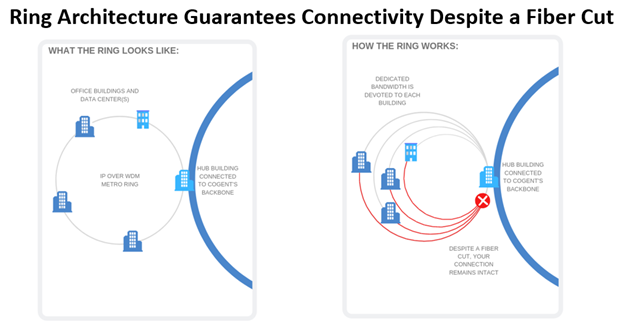
Buying protected services obviates the need for customers to come up with their own redundancy schemes, and may lower overall connectivity costs, as there is no need to buy multiple circuits, since the service provider has already implemented a protection scheme across their own MPLS backbone.
Author:
The Cogent Solutions Engineering team is a group of experienced, technically-versed and business-minded individuals who understand the challenges facing our global customer base, and how Cogent’s set of products and services can address these, from their daily involvement in customer conversations, review of individual customer requirements, solution design, and resulting product development initiatives.